
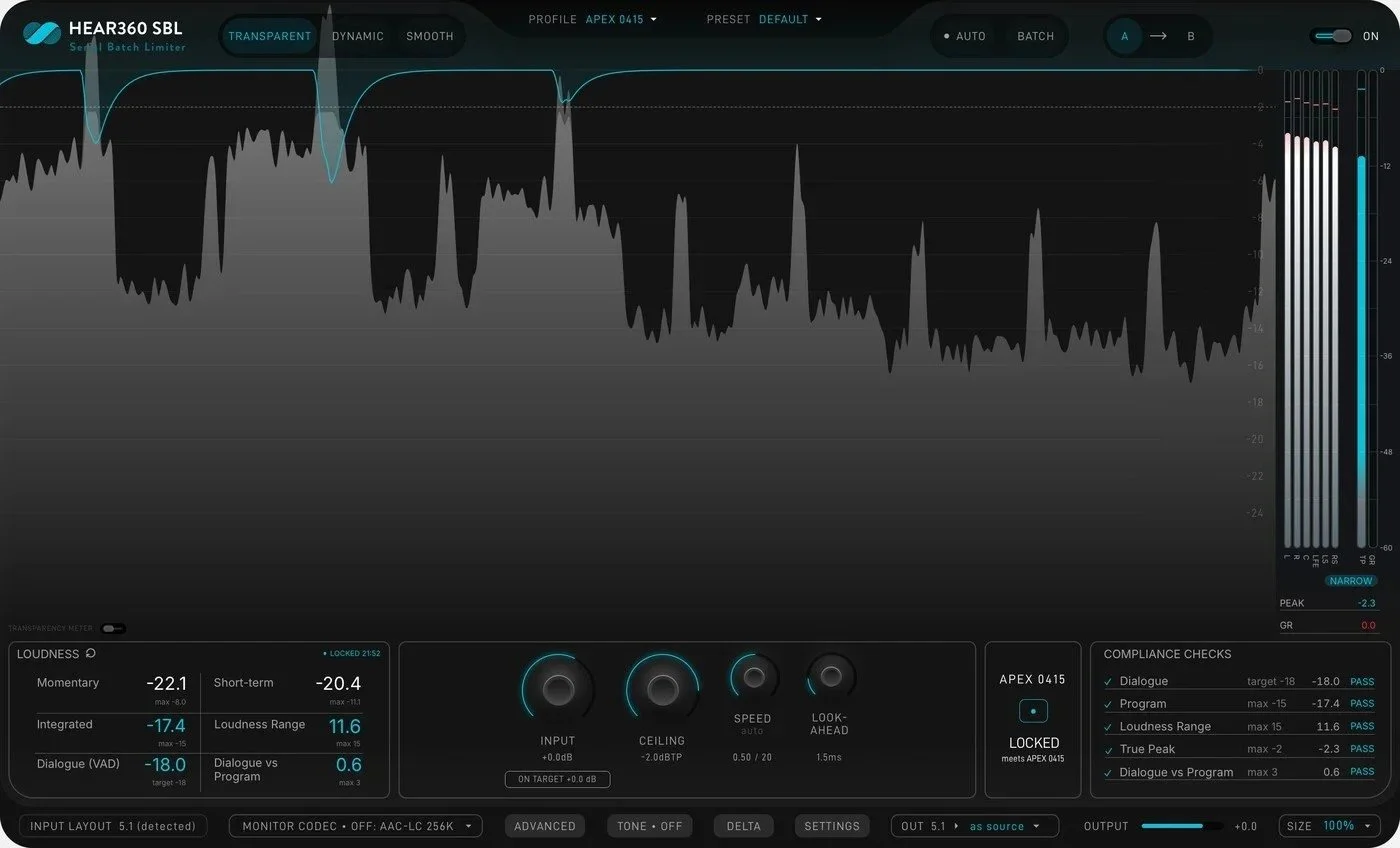
SBL, the Serial Batch Limiter: the program waveform with the gain reduction drawn over it.
The mix is approved. The director is happy, the dialogue sits where it should, and the big third-act sequence finally hits the way everyone wanted.
Then the delivery sheet arrives. The airline version needs a loudness range of 15 LU and a true peak under -2 dBTP. The streaming version wants something else. Somewhere between your mix and those numbers sit 9 dB of peaks that have to go away, and nobody is supposed to hear them leave.
That is a limiter's job. How you ask the limiter to do it makes most of the difference.
One limiter, three jobs
A limiter is a simple idea: when the signal heads over a ceiling, turn it down fast enough that it never gets there. A dB or two of that is invisible.
Delivery work rarely asks for a dB or two. A wide-dynamic-range film mix headed for earbuds or an aircraft cabin needs three things at once. The overall level has to come to target. The loud scenes have to move closer to the quiet ones. And every last peak has to stay under the ceiling.
Hand all three to one limiter and it has to make 6 dB or more of gain change by itself, with one set of timing controls.
Why heavy limiting is audible
Every limiter has a release time, and at heavy settings there is no right answer for it.
Set it slow, and the limiter stays down after each peak. A gunshot ducks the room tone behind it, then the room swells back up. That is pumping.
Set it fast, and the gain recovers so quickly that it starts following the waveform itself, especially on low notes. The limiter is now reshaping the wave, and you hear grit and a thinner low end. That is distortion.
With a couple of dB of reduction, both effects are small enough to ignore. At 6 or 9 dB, you are choosing which artifact you prefer.
What serial limiting is
Serial limiting splits the work. One limiter no longer takes 9 dB. Several limiters in a row each take a small share.
Mixers have done this with compressors for decades. The classic vocal chain is a fast FET compressor catching 2 to 3 dB of peaks, feeding a slow optical compressor that evens out another 2 to 3 dB. Neither one works hard, and the vocal sounds controlled, not squashed.
Mastering engineers carried the trick over to limiters: one to shave the tallest peaks, a second to set the final level. A purpose-built serial limiter takes the idea further, with as many as a dozen stages designed to work as one chain.
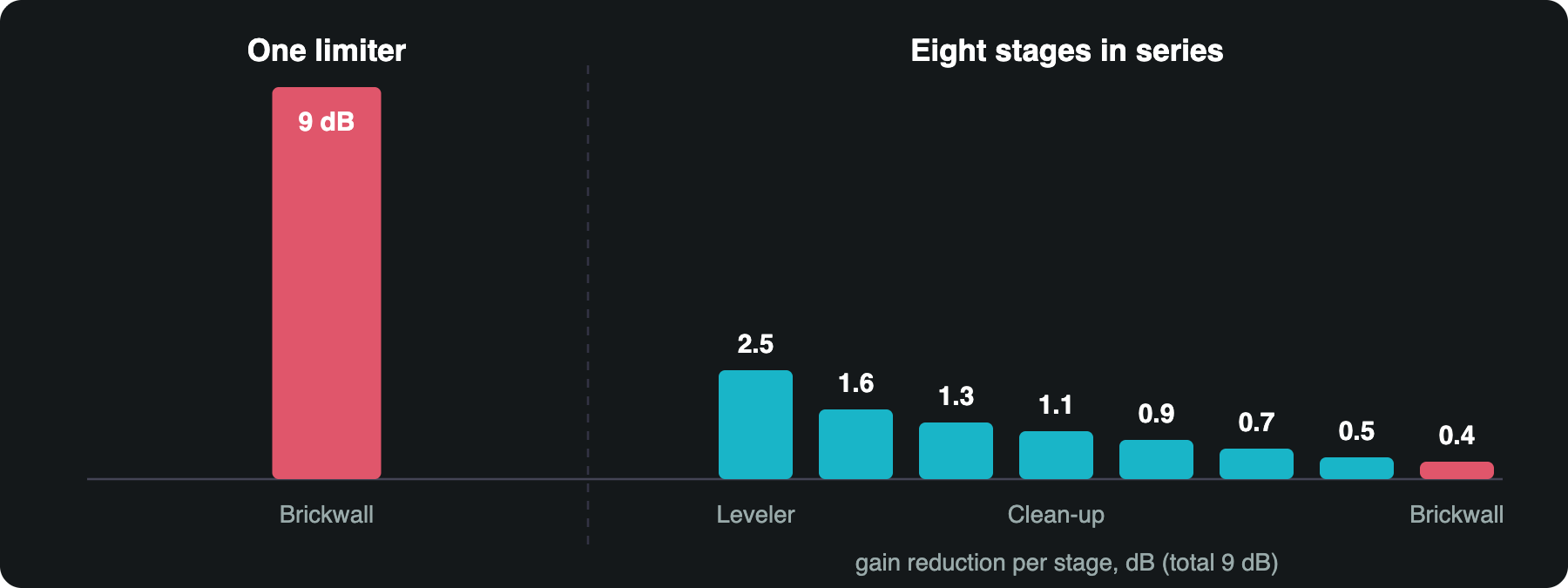
The same 9 dB of gain reduction, taken by one limiter and shared across eight stages. Values are illustrative.
Why small moves add up cleaner
Each stage stays in its comfort zone. A limiter taking 2 or 3 dB behaves like the invisible case above. Nine dB taken as several small steps never asks any one stage to do something you can hear.
Each stage can have its own timing. The first stage can be slow, like a hand on a fader easing a loud scene down. Later stages get faster and deal with shorter and shorter events. Slow stages never chase transients, and fast stages never hold a whole scene down.
Each stage only sees what the last one left. The first stage can start working well above the ceiling and each later one a little lower. Whatever one stage does not take passes to the next. By the final stage there is very little left to catch.
Think of braking for a red light. You can stand on the pedal at the last second, or ease off over a hundred metres. The car stops at the same line both ways. Only one of them spills the coffee.
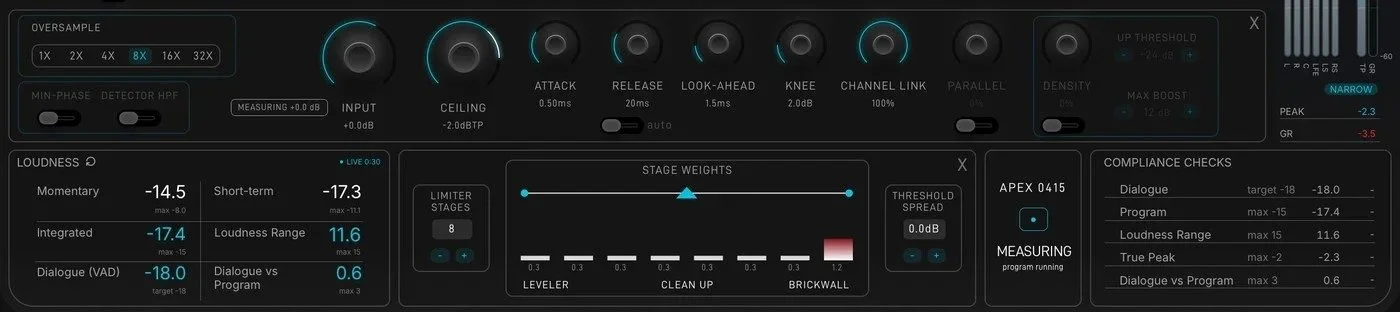
Eight stages at work in SBL's Advanced page: each bar is one stage's gain reduction, from the leveler on the left to the brickwall on the right.
The last stage is different: true peaks
The final stage in the chain is a brickwall, and it has a problem the others do not. The peaks it must catch may not be in the samples at all.
Digital audio stores points on a wave. The wave your converter rebuilds between those points can rise higher than any of them. These are inter-sample peaks, or true peaks, and standards such as EBU R128 and ATSC A/85 set limits on them. A brickwall finds them by oversampling: it rebuilds the wave at several times the sample rate and limits what it sees there.
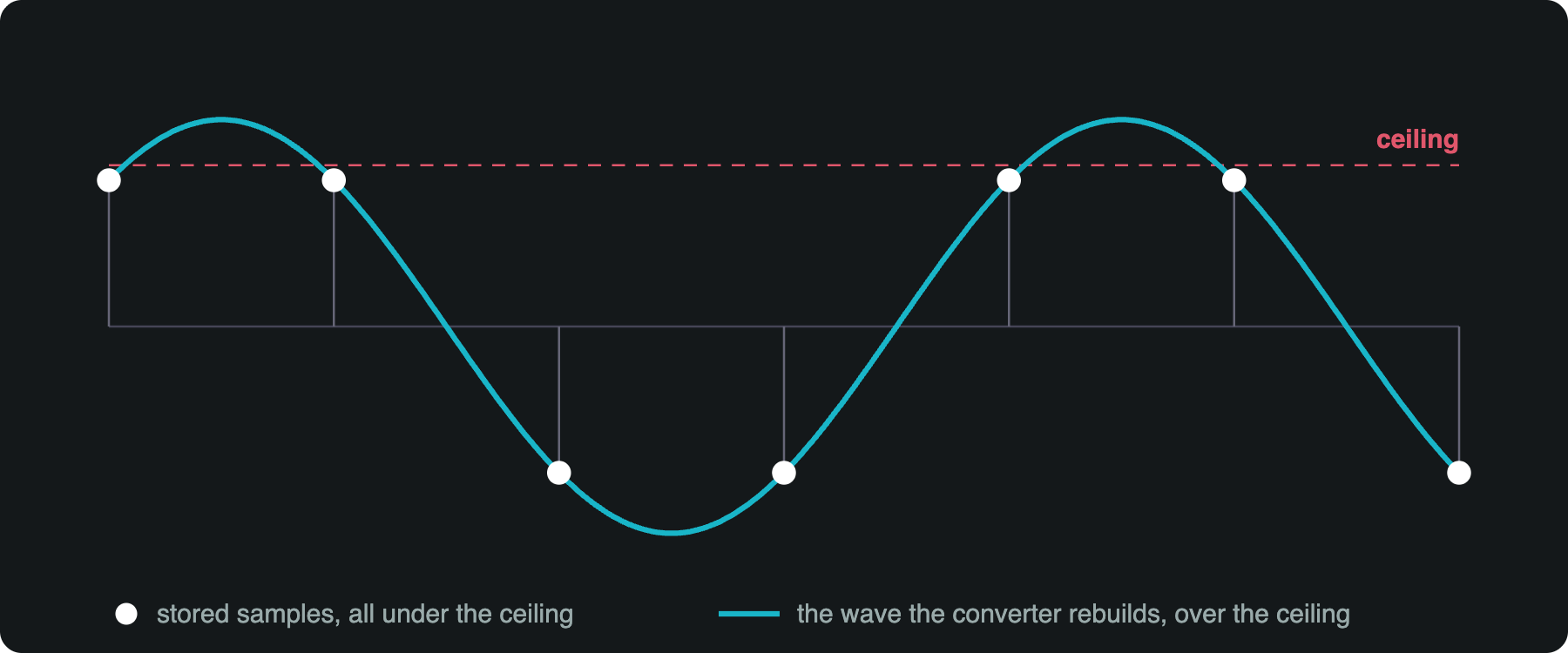
An inter-sample peak: every stored sample sits under the ceiling, but the reconstructed wave between them goes over it.
Lossy codecs add another twist. Encoding to AAC or MP3 changes the waveform slightly. A file that measured legal as a WAV can come back from the encoder with a few moments over the ceiling. The only way to know is to decode the result and measure it again.
Building a serial chain by hand
You can build one from plugins you already own. Four common recipes:
1. Clipper into limiter
A clipper shaves the very tallest peaks so the limiter behind it works less. It is effective on drums and dense music. Clipping is distortion by design, though, and it is risky on dialogue.
2. Compressor into limiter
A slow, low-ratio compressor narrows the range and the limiter holds the ceiling. This is the workhorse, and it is already two stages of the same idea.
3. Two limiters
The first takes a few dB with a slower release, and the second catches what is left. It is more transparent than one limiter, as long as you rebalance the pair whenever the input level changes.
4. Riding the fader
Clip gain and automation ahead of any limiter. This is the most transparent method of all, and the slowest.
All four work. The catch is upkeep. Every stage has a threshold that depends on the stage before it, so a mix that arrives 3 dB hotter throws the whole chain out of balance. Multiply that by a season of 40 files, each at its own level, and the hand-built chain becomes a full-time job.
How to choose a serial limiter
Stages you can see. A meter per stage shows whether the work is really shared, or whether the last stage is doing it all.
Staggered timing and thresholds. Slow to fast and high to low, set for you, with the option to adjust.
Look-ahead on the early stages. The gain should ease down before a peak, not snap at it.
A true-peak brickwall. Oversampled, with a meter that reads true peak the way the spec does.
No hidden saturation. Clipping is a sound. It should be a choice, not a side effect.
Loudness measurement built in. A limiter that knows the target can tell you whether you hit it.
Codec checking. If you deliver AAC, check the AAC.
Latency reporting. A chain of look-ahead stages adds delay, and your host needs to know how much.

Loudness measurement built in: every target of the delivery spec, graded when playback stops.
Getting the most out of serial limiting
Set the level first. Limiting is for peaks. Bring the program to its loudness target with gain, then see what is left over the ceiling.
Watch the last stage. If the brickwall is taking most of the reduction, the earlier stages are not doing their share.
Match the timing to the material. A fast release keeps loud scenes big when only the peaks need control. A slower one suits a mix that needs several dB.
Listen to what was removed. A delta monitor plays only what the limiter changed. If you hear music in it and not just ticks, back off.
Compare at matched loudness. Louder always sounds better for the first few seconds.
Check the delivery, not the session. Measure the file you are sending, after dither and after encoding.
Where SBL fits
SBL, the Serial Batch Limiter, is the tool we built for this job. It runs 2 to 12 limiter stages in series (8 by default): a slow leveler, clean-up stages and an oversampled true-peak brickwall. The first three stages look ahead and ease the gain down before a peak, and no stage adds saturation or clipping.
You pick a delivery profile, such as APEX 0415, EBU R128 or ATSC A/85. SBL sets the targets, measures the result and grades it, including the decoded AAC. It runs as an AAX, VST3 and AU plugin and as a batch app for whole folders, on Apple silicon Macs.
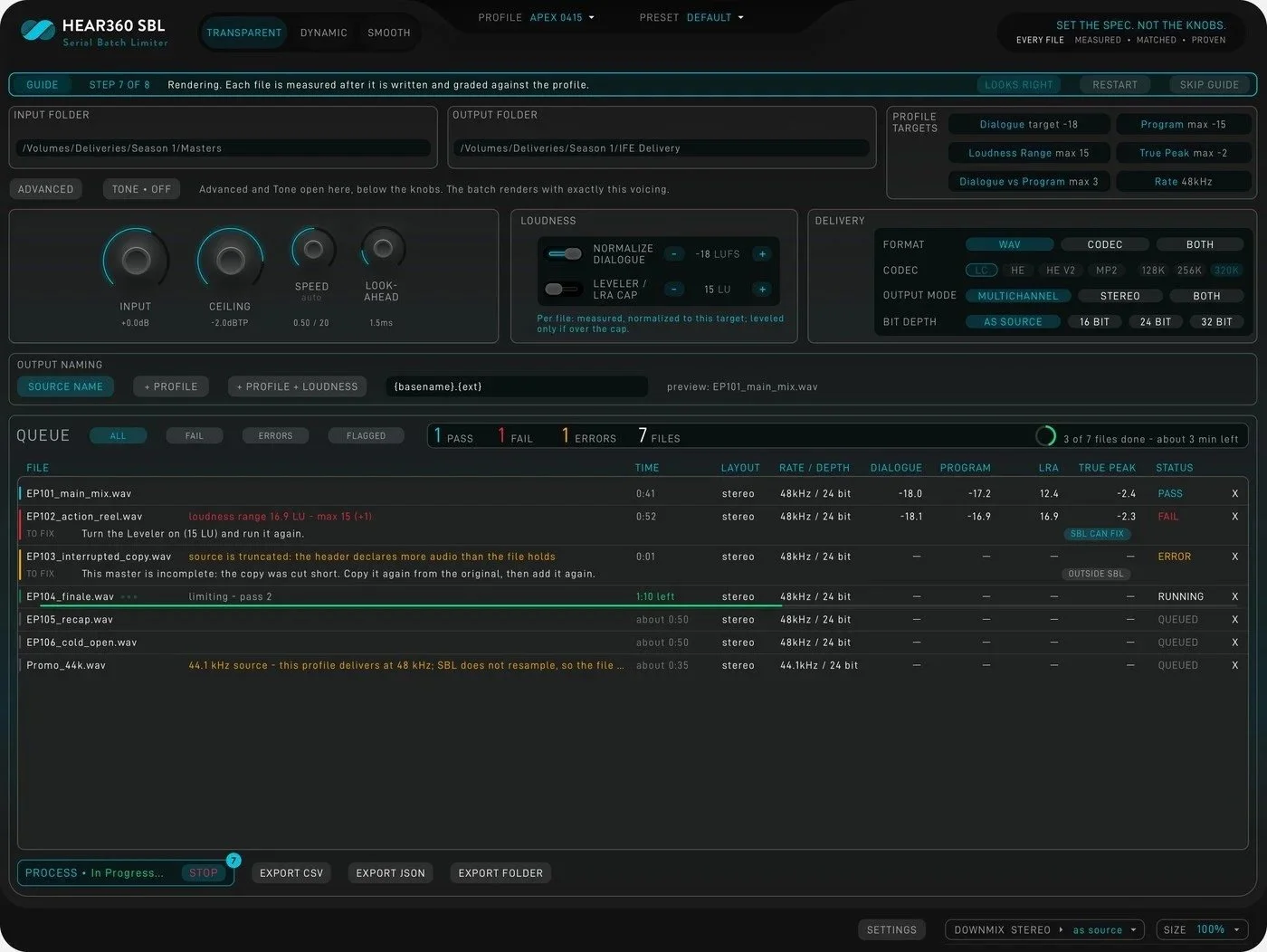
The SBL Limiter app during an example batch run: each file measured, limited and graded against the profile.
FAQ
Is serial limiting the same as multiband limiting?
No. Multiband limiting splits the signal by frequency and limits each band side by side. Serial limiting keeps the whole signal together and splits the work in sequence, one stage after another.
Does serial limiting make a mix louder?
It can, but that is not the point. It lets you take the same amount of gain reduction with fewer artifacts. What you do with that room is up to the spec.
How many stages do I need?
Two is already better than one. More stages mean smaller steps: at 3 dB per stage, 9 dB of reduction needs at least three stages ahead of the brickwall. SBL defaults to eight.
Does a chain of limiters add latency?
Yes. Look-ahead and oversampling both take time. SBL reports about 20 ms at 48 kHz in its default setting, so your host can keep the tracks in sync.
